Most digital marketing services lists are useless for the person reading them. They dump forty service names into a bulleted list, add a stock photo, and leave you exactly where you started: aware that “technical SEO” exists, unsure whether your business needs it, and unable to tell a proposal that makes sense from one that doesn’t.
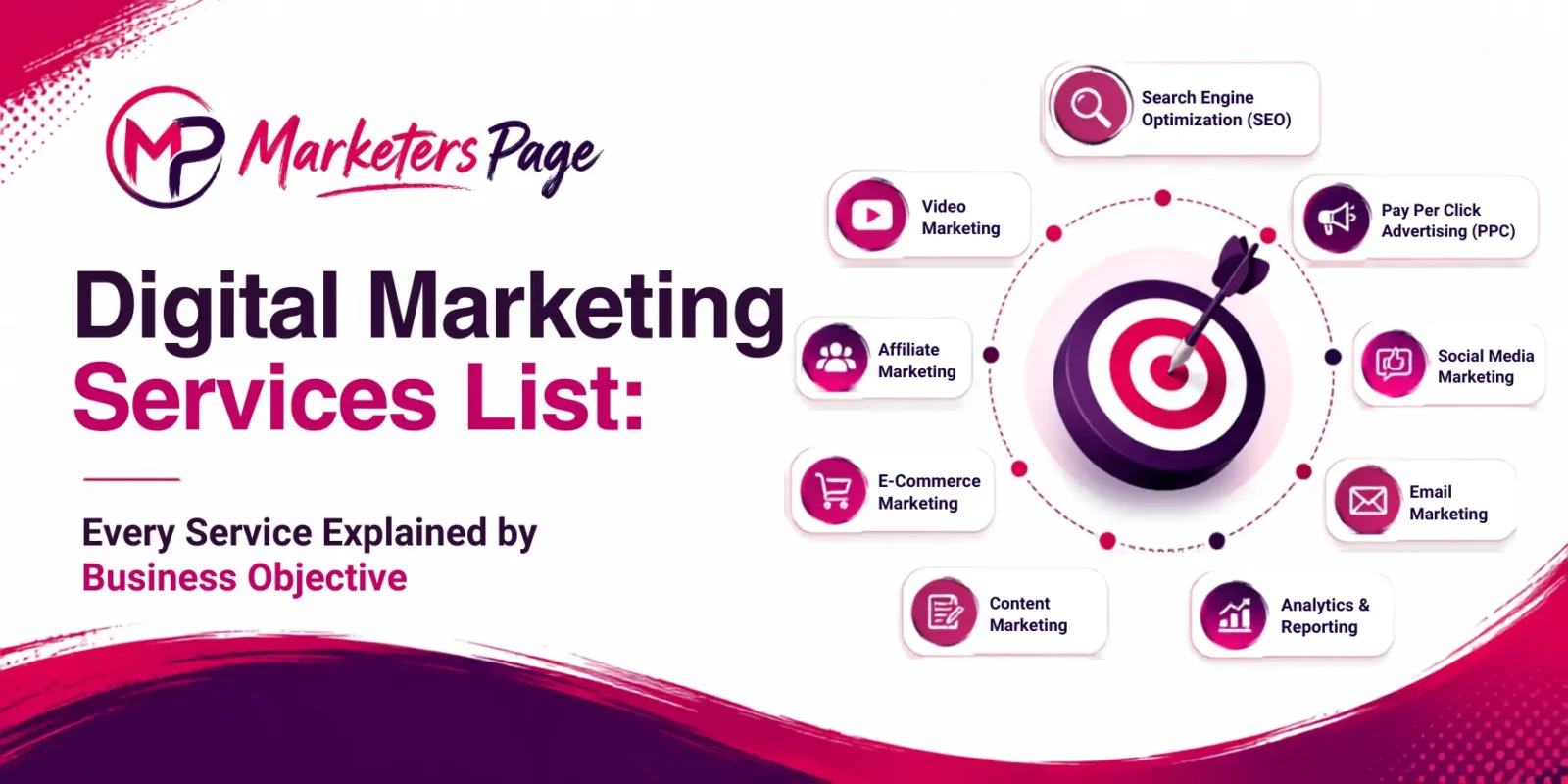
This list is organised differently. Services are grouped by the business objective they serve, each one gets the same seven-point profile so you can compare like with like, and the final section gives you a starting shortlist based on what kind of business you run.
The stakes for getting this right have gone up. According to the Internet in India Report 2025 from IAMAI and Kantar, India now has 958 million active internet users, growing around 8% year on year — and 57% of them, roughly 548 million people, are in rural India, where adoption is expanding nearly four times faster than in urban centres. The audience is no longer concentrated where most businesses assume it is. That makes channel and service selection a genuine strategic decision rather than a formality.
Read this as a scoping tool. By the end you should be able to write a service request an agency can actually quote against, and spot the services someone is trying to sell you that you don’t need yet.
How to read this list
Marketing services are usually catalogued by channel, which is how agencies think, not how businesses buy. A business owner rarely wakes up wanting “off-page SEO.” They wake up wanting more qualified enquiries, a lower cost per sale, or a website that doesn’t embarrass them in front of prospects.
So each category below opens with the objective it serves. Within it, every major service is described using the same structure:
- What it is
- Why businesses use it
- Who needs it
- Typical deliverables
- Common KPIs
- When to use it
- How it pairs with other services
Two things to keep in mind. First, no business needs everything on this list, and any provider who suggests otherwise is selling capacity rather than solving a problem. Second, several of these services depend on others being in place first. The sequencing section near the end covers which ones.
Strategy and consulting services
Objective served: Deciding what to do before spending money doing it.
Digital marketing strategy
What it is: A documented plan connecting business goals to specific channels, budgets, messages and measurement. Not a list of tactics.
Why businesses use it: To stop spending across five channels with no way of knowing which one works.
Who needs it: Any business spending meaningfully on marketing without a written plan. Also any business that has changed its product, market or price point recently.
Typical deliverables: Goal and KPI framework, ideal customer profile, competitor analysis, positioning statement, channel plan with budget allocation, marketing calendar, measurement plan.
Common KPIs: This is an input service, so it’s measured by the performance of what follows. Judge it on whether the plan produced decisions you could act on.
When to use it: Before the first significant spend, and again whenever results plateau for two or more quarters.
How it pairs: Everything else on this list should follow from it. If you want the full method, our step-by-step digital marketing strategy framework walks through building one.
Marketing consulting
What it is: Advisory engagement without execution. An external marketer reviews your setup, diagnoses problems, and recommends fixes your team implements.
Why businesses use it: Cheaper than a retainer when you already have people who can execute but lack senior direction.
Who needs it: Businesses with an in-house marketer or small team, and businesses that suspect their current agency is underperforming but can’t prove it.
Typical deliverables: Audit report, prioritised recommendations, implementation roadmap, occasionally training sessions.
Common KPIs: Measured on the changes it triggers. Track the metrics named in the audit before and after.
When to use it: When you have execution capability but no confidence in direction.
How it pairs: Often precedes a full engagement. Good consultants will tell you which services you don’t need, which is where the value sits.
Market and competitor research
What it is: Structured investigation of demand, customer language, and what competitors are doing across search, social and paid channels.
Why businesses use it: To size the opportunity before committing, and to find gaps competitors have left open.
Who needs it: Businesses entering a new market, launching a new service line, or repeatedly failing to get traction on channels that work for competitors.
Typical deliverables: Search demand analysis, competitor channel breakdown, share of voice estimate, messaging gap analysis, customer language research.
Common KPIs: Share of voice, keyword coverage versus competitors, new opportunities identified.
When to use it: Before entering a market or launching a service line.
How it pairs: Feeds directly into strategy, SEO keyword research, and paid campaign structure.
Customer persona and ICP development
What it is: Defining who you are actually selling to, based on evidence rather than assumption.
Why businesses use it: Because vague targeting produces vague messaging and wasted ad spend.
Who needs it: B2B businesses especially, plus any business whose ads get clicks but no enquiries.
Typical deliverables: Ideal customer profile, two to four buyer personas, objection and trigger mapping, customer journey map.
Common KPIs: Lead quality, close rate, cost per qualified lead.
When to use it: Early, and revisited annually.
How it pairs: Determines paid audience targeting, content topics, and email segmentation.
SEO services
Objective served: Being found in search without paying per click.
SEO is the most commonly mis-sold category on this list, largely because it’s split into sub-services that many buyers can’t distinguish between. Here’s what each actually covers.
Technical SEO
What it is: Making a site crawlable, indexable and fast. Site architecture, page speed, mobile rendering, structured data, canonical handling, index bloat, broken links, redirect chains.
Why businesses use it: Because content and links can’t compensate for a site search engines struggle to read. Google’s own Search Essentials documentation sets out the technical requirements a page must meet before it is eligible to appear in results at all — crawlability and indexability are the floor, not an optimisation.
Who needs it: Sites over roughly 100 pages, ecommerce stores, any site that has been migrated or redesigned, and any site with pages that won’t index.
Typical deliverables: Technical audit, prioritised fix list, implementation or developer handover, Search Console error resolution, structured data markup, Core Web Vitals improvements.
Common KPIs: Indexed pages, crawl errors, Core Web Vitals scores, organic impressions.
When to use it: First, before investing in content. Publishing into a broken site wastes the content budget.
How it pairs: Prerequisite for on-page and content work.
On-page SEO
What it is: Optimising individual pages for the queries they should rank for. Title tags, headings, internal linking, content depth, keyword mapping, search intent alignment.
Why businesses use it: It’s the highest-leverage SEO work on most existing sites, since the pages already exist.
Who needs it: Almost every business with a website more than a year old.
Typical deliverables: Keyword-to-page map, rewritten titles and meta descriptions, content expansions, internal link plan, cannibalisation fixes.
Common KPIs: Keyword rankings, organic clicks, click-through rate from search.
When to use it: After technical fixes, before new content production.
How it pairs: Feeds content marketing, which should extend the keyword map rather than duplicate it.
Off-page SEO and link building
What it is: Earning references from other websites through digital PR, partnerships, directory and citation building, and content that attracts links.
Why businesses use it: Links remain a strong ranking signal in competitive categories.
Who needs it: Businesses competing for commercially valuable, contested keywords. Less urgent for local businesses in low-competition areas.
Typical deliverables: Backlink audit, prospect list, outreach campaigns, digital PR assets, citation cleanup, disavow file where needed.
Common KPIs: Referring domains, link quality, rankings for target terms, referral traffic.
When to use it: After the site is technically sound and the content is genuinely worth linking to.
How it pairs: Wasted without on-page and content work behind it.
A caution: This is the sub-service where bad providers do real damage. Google explicitly classifies buying or selling links for ranking purposes as link spam, and sites caught doing it can lose visibility. Ask any provider exactly how links are acquired, and refuse vague answers.
Local SEO
What it is: Ranking in map results and location-based searches. Google Business Profile optimisation, local citations, review generation, location pages, local link building.
Why businesses use it: Local intent searches convert quickly, often within a day — and reputation signals do heavy lifting in the decision.
The numbers behind that are worth knowing. In BrightLocal’s Local Consumer Review Survey 2025, only 4% of consumers said they never read online business reviews, and 74% check two or more review sites before deciding on a local business. That last figure matters: it means a well-maintained Google Business Profile alone isn’t enough if your Justdial or Facebook listing is stale or unanswered.
The same research found something counterintuitive. The share of consumers who trust online reviews as much as a personal recommendation from friends or family has fallen sharply — from 79% in 2020 to 42% in 2025. Consumers are still reading reviews heavily; they’re just reading them more sceptically, looking for detail and balance rather than taking a star rating at face value. A wall of identical five-star one-liners now does less work than a smaller set of specific, detailed reviews with a visible owner response.
Caveat: BrightLocal surveyed a representative panel of 1,026 US adults. Indian consumer behaviour differs in platform mix — Justdial, WhatsApp and word-of-mouth carry weight that US data doesn’t capture. Treat the direction as instructive and the exact percentages as US-specific.
Who needs it: Any business serving customers in a defined geographic area. Clinics, restaurants, retailers, service contractors, professional practices, agencies.
Typical deliverables: Google Business Profile setup and optimisation, category and service configuration, citation building and cleanup, review strategy, local landing pages, local schema.
Common KPIs: Map pack rankings, profile views, direction requests, calls from profile, local organic traffic.
When to use it: Immediately, if you serve a local market. It’s usually the fastest organic return available.
How it pairs: Works alongside reputation management and paid local campaigns. Note that BrightLocal also found email to be the single most effective way to request a review, with 40% of consumers saying they’d be most likely to respond to an email ask — so review generation is really an email marketing task wearing a local SEO hat.
Ecommerce SEO
What it is: SEO adapted to product and category pages. Faceted navigation control, product schema, category page optimisation, out-of-stock handling, duplicate content management.
Why businesses use it: Product searches carry purchase intent, and organic visibility reduces dependence on paid shopping campaigns. The Indian market for this is substantial and still expanding — the IAMAI report found 230 million urban internet users, 56% of the urban active base, shopped online in the past year.
Who needs it: Online stores with more than a handful of products.
Typical deliverables: Category keyword mapping, product page templates, faceted navigation rules, product structured data, internal linking structure, indexation controls.
Common KPIs: Organic revenue, organic conversion rate, category page rankings, indexed product pages.
When to use it: Once the store has stable inventory and a working checkout.
How it pairs: Directly supports Shopping campaigns by improving the same feed and page quality.
SEO audits and keyword research
What it is: Diagnostic work. An audit finds what’s wrong; keyword research finds what to target.
Why businesses use it: To avoid paying for a twelve-month retainer aimed at the wrong problem.
Who needs it: Anyone about to commission SEO work, and anyone whose current SEO investment isn’t moving.
Typical deliverables: Audit document with prioritised issues, keyword map with search volume, difficulty and intent, content gap analysis.
Common KPIs: Diagnostic, so measured by the accuracy of what follows.
When to use it: Before committing to an ongoing SEO engagement.
How it pairs: Should determine the scope of every other SEO sub-service you buy.
Content marketing services
Objective served: Earning attention and trust before someone is ready to buy.
| Service | What it produces | Primary use | Common KPIs |
| Content strategy | Topic clusters, editorial calendar, briefs | Direction for all content production | Coverage of target topics, organic growth |
| Blog and article writing | Published articles targeting search demand | Organic traffic and topical authority | Organic sessions, rankings, assisted conversions |
| Landing page copy | Conversion-focused page copy | Turning traffic into enquiries | Conversion rate, form completions |
| Case studies | Documented client results | Sales enablement, trust building | Influenced pipeline, page engagement |
| Whitepapers and lead magnets | Gated assets in exchange for contact details | Building an email list | Downloads, cost per lead, list growth |
| Video content | Short and long-form video | Social reach, product explanation | Views, watch time, view-through conversions |
| User-generated content | Customer photos, reviews, testimonials | Social proof at low production cost | Engagement rate, conversion lift on pages using it |
Two things worth stating plainly about this category.
Volume is not the goal. Publishing weekly is only useful if each piece targets a real query or answers a real objection. Twenty well-targeted pages usually outperform two hundred thin ones. Google’s helpful content guidance is explicit that content created primarily to attract search traffic, rather than to help a reader, is unlikely to perform.
Content without distribution is a hobby. If nothing in the plan explains how each asset gets found — through search demand, email, social distribution or paid promotion — the content budget is at risk.
Social media services
Objective served: Building an audience and staying present where your customers already spend time.
Social media management
What it is: Ongoing content planning, creation, scheduling, publishing and community response across chosen platforms.
Why businesses use it: Consistency. Most in-house attempts fail on cadence, not on ideas.
Who needs it: Consumer-facing brands, local businesses, and B2B companies where founders or executives are the credible voice.
Typical deliverables: Content calendar, post creatives and copy, publishing, comment and DM response, monthly reporting.
Common KPIs: Reach, engagement rate, follower growth, profile-to-website clicks, enquiries from social.
When to use it: Once you know which one or two platforms your customers actually use. Running five badly is worse than running one well.
How it pairs: Feeds and is fed by content marketing. Distinct from social advertising, which is a paid service.
Influencer and creator marketing
What it is: Paid or gifted partnerships with people who already have your audience’s attention.
Why businesses use it: Borrowed trust, and access to audiences that are expensive to reach through ads.
Who needs it: Consumer products, hospitality, healthcare and wellness, education, local services with a visual proposition.
Typical deliverables: Creator identification and vetting, outreach and negotiation, brief development, content approval, disclosure compliance, performance tracking.
Common KPIs: Reach, engagement, referral traffic, promo code redemptions, cost per acquisition.
When to use it: After you have a landing page and tracking capable of measuring what the traffic does.
How it pairs: Creator content can often be reused in paid social, frequently outperforming brand-produced creative.
Compliance note: India’s ASCI influencer advertising guidelines require clear, upfront disclosure on material connections. Any provider running creator campaigns should be handling disclosure as standard, not as an afterthought.
Short-form video
What it is: Vertical video production for Reels, Shorts and similar surfaces.
Why businesses use it: It remains the highest-reach organic format, and in India the scale is now hard to ignore — the IAMAI and Kantar report found 588 million users, 61% of the country’s internet population, consumed short-video content in 2025, with rural users marginally outnumbering urban ones.
Video also plays a specific role in local purchase decisions. BrightLocal’s 2025 survey found that over three-quarters of consumers watch some form of video when researching a local business, and the single most-consumed format was video posted by the business itself — ahead of influencer content and content from friends. If you serve a local market, your own footage is doing more work than you probably think.
Who needs it: Any business with something visual to show, a person willing to appear on camera, or a process worth explaining.
Typical deliverables: Concept development, scripting, filming or editing, captioning, posting schedule.
Common KPIs: Views, watch-through rate, saves and shares, follower growth, profile clicks.
When to use it: When you can commit to a sustained run. Sporadic posting produces sporadic results.
How it pairs: Doubles as paid social creative and as on-site content.
Paid advertising services
Objective served: Buying attention now, with measurable cost per outcome.
| Service | Platform | Best-suited demand | Primary KPI |
| Google Search Ads | Existing, expressed demand | Cost per conversion | |
| Microsoft Ads | Bing, Yahoo | Same as above, smaller volume, often lower CPC | Cost per conversion |
| Meta Ads | Facebook, Instagram | Latent demand, audience building | Cost per lead, ROAS |
| LinkedIn Ads | B2B, role and firmographic targeting | Cost per qualified lead | |
| YouTube Ads | YouTube | Awareness, product explanation, retargeting | View-through rate, assisted conversions |
| Display advertising | Google Display, programmatic | Reach and retargeting | Impressions, view-through conversions |
| Retargeting | All major platforms | Recovering non-converting visitors | Return on ad spend |
| Shopping campaigns | Google, Meta | Product purchase intent | ROAS, cost per acquisition |
What every paid service should include: account structure and setup, keyword or audience research, ad creative and copy, conversion tracking configuration, landing page recommendations, ongoing bid and budget management, negative keyword or exclusion management, and reporting that shows cost per outcome rather than only impressions and clicks.
The most common failure in this category is running paid campaigns before conversion tracking is correctly configured. Without it, optimisation is guesswork and reporting describes activity rather than results. Analytics implementation belongs before the first campaign goes live, not after.
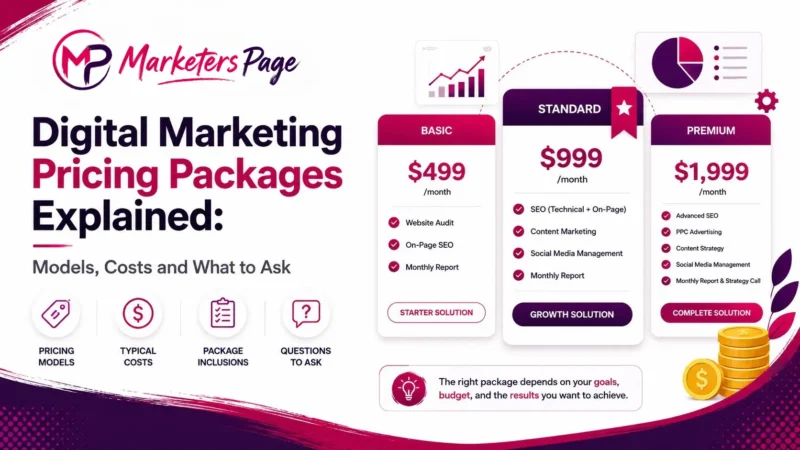
Paid services are also where the pricing model matters most, because management fees are often charged as a percentage of ad spend. That structure has incentive implications worth understanding before signing. We cover it in detail in our guide to how digital marketing pricing works.
Website and conversion services
Objective served: Turning the traffic you already have into enquiries and sales.
Website design and development
What it is: Building or rebuilding the site itself, including structure, design, content templates and technical foundation.
Why businesses use it: Every other service sends traffic here. A weak site caps the return on all of them — and for B2B in particular, the site is doing more selling than your sales process is. Gartner’s research on the B2B buying journey found that 75% of B2B buyers say they prefer a rep-free purchase experience, and that buyers interact with supplier websites more than any other form of supplier digital contact.
Who needs it: Businesses with sites that are slow, not mobile-friendly, hard to update, or built on a platform that limits SEO.
Typical deliverables: Sitemap and wireframes, design, build, content migration, speed optimisation, analytics setup, training handover.
Common KPIs: Page speed and Core Web Vitals, bounce and engagement rate, conversion rate, organic visibility post-launch.
When to use it: Before scaling traffic acquisition, not during.
How it pairs: A redesign without SEO involvement is one of the most reliable ways to lose existing rankings. Technical SEO belongs in the project from the wireframe stage.
Landing page development
What it is: Standalone pages built for a single campaign or offer.
Why businesses use it: Homepages convert paid traffic poorly because they serve too many audiences at once.
Who needs it: Anyone running paid campaigns.
Typical deliverables: Page copy, design, build, form and tracking setup, variant versions for testing.
Common KPIs: Conversion rate, cost per conversion, form abandonment.
When to use it: Alongside every paid campaign launch.
Conversion rate optimization and A/B testing
What it is: Systematic improvement of conversion rate through research, hypothesis and controlled testing.
Why businesses use it: Improving conversion rate raises the return on every traffic source simultaneously, without increasing spend.
Who needs it: Sites with enough traffic for testing to reach statistical significance. Below that threshold, qualitative research and heuristic fixes are more practical than formal A/B tests — the Nielsen Norman Group’s guidance on usability testing makes the case that a small number of moderated sessions surfaces the majority of usability problems, which is often the better first move for a low-traffic site.
Typical deliverables: Conversion audit, heatmap and session recording analysis, user testing, prioritised hypothesis backlog, test design and execution, results documentation.
Common KPIs: Conversion rate, revenue per visitor, test win rate.
When to use it: Once traffic is consistent and tracking is reliable.
How it pairs: Multiplies the value of SEO and paid advertising. Frequently the highest-return service available to a business already generating traffic.
Analytics implementation
What it is: Setting up measurement properly. GA4 configuration, conversion and event tracking, tag management, ecommerce tracking, cross-platform integration.
Why businesses use it: Because you cannot optimise what you cannot measure, and most accounts we encounter are measuring the wrong events or double-counting them.
Who needs it: Everyone. This is the least glamorous and most frequently skipped service on the list.
Typical deliverables: Measurement plan, GA4 and Tag Manager configuration, conversion event setup, platform conversion imports, data layer implementation where required.
Common KPIs: Tracking accuracy and coverage, rather than a performance metric of its own.
When to use it: First. Before any paid campaign, before any CRO work.
Email and CRM services
Objective served: Converting and retaining the audience you’ve already paid to acquire.
| Service | What it does | Who needs it most |
| Email marketing | Campaigns and newsletters to a subscriber list | Ecommerce, content businesses, B2B |
| Marketing automation | Triggered sequences based on behaviour | Businesses with long or multi-step buying cycles |
| Lead nurturing | Structured follow-up for leads not yet ready to buy | B2B, high-consideration services |
| Segmentation | Dividing the list by behaviour, stage or profile | Any list above a few thousand contacts |
| Lifecycle marketing | Onboarding, retention and win-back programmes | Subscription and repeat-purchase businesses |
| CRM marketing | Using sales data to inform marketing | B2B with a defined sales process |
Email remains one of the few channels you own outright. Social reach depends on platform algorithms and paid reach depends on continued spend, but a subscriber list travels with you. That makes list building a defensible asset, which is why lead magnets and content offers appear in the content category above.
On returns: Litmus reports an average of $36 returned for every $1 spent on email, which is the source of the figure you’ll see quoted across the industry. Worth reading with care — it comes from a survey of marketing professionals reporting their own results, not from audited revenue data, and self-reported ROI skews high. Treat it as evidence that email is usually worth doing, not as a number you can budget against.
The practical constraint is that automation without segmentation produces the same generic sequence for everyone. If a provider proposes automation, ask what the segmentation logic is before agreeing. Also confirm they are handling consent and data storage in line with India’s Digital Personal Data Protection Act, 2023, which changes what you can do with contact data collected through forms and lead magnets.
Analytics and measurement services
Objective served: Knowing what worked and what didn’t.
- Reporting dashboards. Consolidated views across channels, updated automatically. Removes the monthly scramble to assemble numbers manually.
- Attribution modelling. Assigning credit across touchpoints. Increasingly difficult as privacy restrictions reduce cross-site tracking, which is why first-party data collection matters more than it did.
- Conversion tracking. Ensuring every meaningful action is recorded correctly and once.
- Marketing performance analysis. Interpretation rather than reporting. What the numbers mean and what to change.
The distinction worth insisting on: reporting tells you what happened, analysis tells you what to do. Many retainers include the first and quietly omit the second. Check which you’re buying.
Emerging and AI-driven services
Objective served: Staying visible as search and discovery behaviour changes.
AI search optimization
What it is: Optimising for visibility in AI-generated answers, including AI Overviews and AI assistants, alongside traditional rankings.
Why businesses use it: Because a growing share of queries now end without a click. Pew Research Center tracked the actual browsing behaviour of 900 US adults across nearly 69,000 Google searches in March 2025, and found that 58% encountered at least one AI-generated summary. On search pages where a summary appeared, users clicked a traditional result on 8% of visits, compared with 15% where no summary appeared. Clicks on sources cited inside the summary itself were rarer still, at 1% of visits.
Two conclusions follow, and they pull in opposite directions. Ranking below an AI summary produces fewer visits than the same ranking did before. But being cited inside the summary is now a visibility outcome in its own right, even when it doesn’t produce a click — which means brand recall and branded search become more important measures than they used to be.
The Indian picture is moving the same way. The IAMAI and Kantar report found around 44% of India’s internet users now use AI features such as voice or image search, chatbots and filters, rising to 57% among 15–24 year-olds.
Caveat: the Pew figures come from a US panel measured in March 2025. AI Overview rollout, query mix and click behaviour vary by country and have continued to shift since.
Who needs it: Businesses whose customers ask informational questions before buying. Less urgent for businesses driven by transactional, navigational or purely local intent.
Typical deliverables: Entity and brand consistency work, structured data, clear direct answers within content, source credibility signals, monitoring of AI answer visibility.
Common KPIs: Citation frequency in AI answers, branded search volume, impressions against clicks in Search Console.
When to use it: As an extension of existing SEO, not a replacement.
A note on hype: this category attracts inflated claims. There is no verified method for guaranteeing inclusion in AI-generated answers, and any provider promising one is overstating what’s known. Treat it as a sensible adjustment to good SEO practice, not a separate product.
AI-assisted content workflows
What it is: Using AI tools for research, drafting, and production support, with human editorial oversight and subject-matter input.
Why businesses use it: Speed and volume, at lower production cost.
Who needs it: Content-heavy operations. Less relevant for businesses publishing occasionally.
Typical deliverables: Workflow design, prompt and brief templates, editorial review process, quality control standards.
The condition: unreviewed AI output is a liability, not an asset. Google’s position is that automation is acceptable when it produces genuinely helpful content and a problem when it exists mainly to manipulate rankings — the distinction rests on editorial input, not on whether AI was involved. Ask any provider what their human review process is, and what subject-matter input goes into each piece.
First-party data strategy
What it is: Building direct data collection through your own site, email list, CRM and customer interactions, reducing reliance on third-party tracking.
Who needs it: Any business currently dependent on platform targeting data, particularly ecommerce and consumer brands.
Typical deliverables: Data collection audit, consent management, CRM integration, server-side tracking, enriched audience segments.
How these services depend on each other
Buying in the wrong order wastes money. A rough sequencing map:
Foundation, before anything else:
Analytics implementation → website functional and fast → technical SEO baseline.
Then, demand capture:
Keyword research → on-page SEO → Google Ads or local SEO, depending on whether you serve a local market.
Then, demand generation:
Content marketing → social media → email list building → retargeting.
Then, efficiency:
CRO → automation and segmentation → attribution and analysis.
Then, scale:
Link building → additional paid platforms → influencer and video → expanded content programmes.
The two most common sequencing mistakes: running paid ads before conversion tracking exists, and commissioning content before the site can be crawled properly. Both spend budget on activity that can’t produce measurable return.
If you want the decision framework for making these calls against your own goals and budget, our digital marketing strategy guide covers channel selection and sequencing in full.
Which digital marketing services does your business actually need?
These are starting shortlists, not prescriptions. Adjust based on your market’s competitiveness and your existing assets.
Local businesses (clinics, retailers, restaurants, contractors, professional practices)
Start here: Local SEO and Google Business Profile optimisation, review generation, a fast mobile-friendly website, Google Search Ads for high-intent local terms, analytics implementation.
Add later: Social media management, short-form video, content marketing for common customer questions.
Skip for now: Link building campaigns, LinkedIn Ads, marketing automation, attribution modelling.
Given that 74% of consumers check two or more review platforms, review consistency across listings is a higher priority here than most local businesses treat it.
Startups (pre-product-market-fit or early revenue)
Start here: Positioning and ICP work, analytics implementation, one paid channel for fast learning, landing pages, basic email capture.
Add later: Content marketing and SEO once positioning is stable, CRO once traffic is consistent.
Skip for now: Broad multi-channel programmes, extensive content production, influencer marketing.
The failure mode here is spending on SEO and content before the positioning settles. Both take months to compound, and both need rewriting if the proposition changes.
Ecommerce businesses
Start here: Ecommerce SEO, Google Shopping, Meta Ads, email marketing with automated flows, analytics and conversion tracking, CRO.
Add later: Influencer and creator marketing, user-generated content programmes, retention and lifecycle marketing, first-party data strategy.
Skip for now: LinkedIn Ads, long-form B2B content.
B2B companies
Start here: ICP and persona development, LinkedIn Ads or Google Search Ads on commercial terms, landing pages, content addressing buying-committee objections, CRM integration, lead nurturing.
Add later: SEO for consideration-stage topics, case studies, webinars, account-based programmes.
Skip for now: High-volume social posting, broad awareness campaigns.
Gartner’s research is worth internalising here: B2B buying doesn’t move in a straight line, but loops across six recurring “buying jobs” — problem identification, solution exploration, requirements building, supplier selection, validation and consensus creation — with buyers revisiting each at least once. Gartner also found that 99% of B2B purchases are triggered by some organisational change rather than by a vendor’s outreach. Practically, that means your content needs to serve stakeholders arriving at different jobs at different times, not funnel everyone through one linear nurture sequence.
SaaS businesses
Start here: SEO for problem and comparison queries, content marketing, product-led landing pages, conversion tracking through to trial and activation, lifecycle email.
Add later: Paid search on competitor and category terms, YouTube for product education, review platform presence.
Professional services (legal, financial, consulting, healthcare)
Start here: Local SEO where relevant, credibility content demonstrating expertise, a website that signals trust, review and reputation management, Google Search Ads on high-intent terms.
Add later: Thought leadership content, LinkedIn presence for the practitioners themselves, email nurture for long consideration cycles.
Regulatory constraints apply in several of these sectors, and they are strict in India — the Bar Council of India rules restrict advertising by advocates, and medical practitioners are bound by National Medical Commission conduct regulations. Confirm any provider understands the rules governing your profession before work begins.
Established enterprises
Start here: Attribution and measurement infrastructure, consolidated reporting, CRO, first-party data strategy.
Add later: Programmatic and display, omnichannel coordination, incrementality testing.
At this stage the constraint is rarely more activity. It’s usually knowing which existing activity to stop.
Services most businesses over-buy
- Content volume without a distribution plan or keyword targeting.
- Multiple social platforms maintained badly rather than one maintained well.
- Link building commissioned before the site has anything worth linking to.
- Marketing automation bought before there’s a list large or segmented enough to justify it.
- Display advertising run for awareness with no measurement framework attached.
Services most businesses under-invest in
- Analytics implementation. Skipped almost universally, and it undermines everything downstream.
- Conversion rate optimization. Improves the return on all traffic simultaneously.
- Email marketing. The one channel you own, consistently under-resourced relative to its return.
- Local SEO. For businesses serving a defined area, usually the fastest organic return available.
- Technical SEO. Invisible until it isn’t, and expensive to retrofit after a redesign.
How to scope a service request properly
Providers quote wildly different figures for what sounds like the same scope, largely because the scope wasn’t defined. A request that gets comparable quotes includes:
- The business outcome you want, stated as a number where possible, not the service name.
- What already exists. Website platform, current traffic, existing accounts, current agency arrangements.
- Your constraints. Budget range, timeline, internal capacity, regulatory requirements.
- What you can measure today. Be honest if tracking is unreliable, because fixing it will be part of the work.
- Decision criteria. What you’ll judge the engagement on, and when.
Send the same brief to every provider. If two quotes differ by a wide margin, the difference is almost always in scope depth, seniority of the people doing the work, or deliverable frequency. Ask which.
FAQs
What services does a digital marketing agency provide?
Most agencies offer some combination of strategy, SEO, content marketing, social media management, paid advertising, website and conversion work, email marketing and analytics. Few do all of them well. Ask which two or three they’re genuinely strongest in, and how they staff the rest.
Which digital marketing service gives the fastest results?
Paid advertising, typically within days, provided conversion tracking is in place and the landing page works. Local SEO is often the fastest organic option for businesses serving a defined area. SEO and content marketing generally take several months before compounding.
Do I need SEO if I’m already running paid ads?
They solve different problems. Paid delivers immediate, controllable volume that stops when spending stops. SEO builds an asset that continues producing traffic, but slowly. Most businesses eventually want both. If budget forces a choice, start with paid to validate which messages and offers convert, then invest in SEO for the terms that proved profitable.
Should a new business start with SEO or paid advertising?
Usually paid, because it produces learning faster. You’ll discover which audiences, messages and offers work within weeks rather than months, and that knowledge makes the eventual SEO investment far better targeted.
What’s the difference between social media management and social media advertising?
Management covers organic content, posting and community interaction. Advertising covers paid placements bought through platform ad managers. They use the same platforms but different skills, budgets and success metrics. Confirm which one a proposal includes — assuming it covers both is a common misunderstanding.
Do small local businesses need content marketing?
In a limited form. Pages answering the questions customers actually ask — pricing explanations, process descriptions, service area information — do useful work. A weekly blog usually does not.
What’s the minimum viable set of services for a startup?
Working analytics, a landing page that converts, one paid channel, and email capture. That combination lets you learn what works before spending on anything broader.
Are AI Overviews really reducing website traffic?
The evidence points that way. Pew’s tracking of real browsing behaviour found clicks on search results roughly halved when an AI summary was present, from 15% of visits to 8%. That said, the study covered US users in a single month, and the effect varies significantly by query type — transactional and local searches are far less affected than informational ones.
What is AI search optimization and do I need it yet?
It’s optimising for visibility in AI-generated answers alongside conventional rankings. It matters most if your customers ask informational questions before buying. It’s largely an extension of good SEO practice rather than a separate service, and claims of guaranteed inclusion in AI answers should be treated sceptically.
Can I buy services individually or must I take a package?
Both are available. Individual services suit specific, well-defined problems. Packages suit ongoing programmes across multiple channels. Packaged pricing is often better value if you genuinely need everything included, and poor value if you’re paying for components you don’t use.
Which services should be in-house versus outsourced?
Keep anything requiring deep product or customer knowledge in-house, particularly positioning, messaging and customer research. Outsource work needing specialist tooling or infrequent expertise, such as technical SEO, paid media management and analytics implementation.
How do I know a service is actually working?
Agree on the metric before work starts, and make sure it’s a business metric rather than an activity metric. Posts published, links built and pages optimised describe effort. Enquiries, qualified leads, cost per acquisition and revenue describe results. If a monthly report only contains the first kind, ask for the second.
Where to go from here
You now have a scoped view of what exists and a shortlist for your business type. Two next steps depending on where you are.
If you’re still deciding what to prioritise and in what order, work through the 10-step digital marketing strategy framework and fill in the template. If you’re ready to get quotes, read how digital marketing pricing packages work before you request them, because knowing how providers structure fees is the difference between comparing proposals and guessing between them.
And if a term in this list wasn’t clear, our digital marketing fundamentals guide has the full glossary.