Ask two industry surveys what digital marketing costs and you get answers that differ by more than three times.
Ahrefs polled 439 SEO providers worldwide and found an average monthly cost of $2,917, with agencies averaging $3,209 and consultants $3,250. SE Ranking, surveying agencies in partnership with Duda, found that 64% charge under $1,000 per month.
Both surveys are honest. They measured different slices of the same market — one weighted toward established agencies with larger clients, the other capturing more freelancers and small shops. But the gap tells you something important before you read another word: there is no market rate. Anyone who quotes you one is describing their own business, not an industry standard.
That’s the actual problem with digital marketing pricing. Not that it’s expensive, but that it’s illegible. This guide is about making it legible — what the models are, what actually drives the number up or down, and how to test whether a quote and a scope belong to each other.
What a digital marketing pricing package actually is
A digital marketing pricing package is a bundled set of services sold at a fixed price, usually monthly, covering an agreed list of deliverables across one or more channels. Packages exist because they simplify buying and give agencies predictable revenue. They fail when the deliverable list has no clear relationship to the outcome you’re paying for.
Bundling is close to universal. SE Ranking found that 85% of agencies package their services rather than selling them purely à la carte, and 93% offer other services alongside their core one. So the question is rarely whether you’ll be offered a package. It’s whether the package fits.
How agencies charge: the six pricing models
| Model | How it works | Best for | Main risk to you |
|---|---|---|---|
| Monthly retainer | Fixed fee, recurring, agreed deliverables | Ongoing multi-month work | Paying for deliverables you don’t need this month |
| Project-based | Fixed fee, defined scope, end date | Audits, migrations, builds, launches | Scope creep disputes; no ongoing accountability |
| Hourly | Billed against logged time | Advisory, troubleshooting, training | Open-ended cost on unbounded work |
| Performance-based | Fee tied to results | Rare; usually layered on a base fee | Distorted incentives; disputed attribution |
| Percentage of ad spend | Fee as % of media budget | Paid media management at scale | Rewards spending more, not spending better |
| Value-based / custom | Priced against business outcome | Complex or high-stakes engagements | Hard to compare against alternatives |
Retainers dominate. Ahrefs found 78.2% of providers use them; SE Ranking found 53% prefer them as their primary model. Most agencies run two or three models simultaneously depending on client type.
Monthly retainers — what they cover and where they leak
A retainer buys you continuity: the same team, working on your account every month, compounding what they built the month before. For SEO, content and social media, that continuity is most of the value, because none of those disciplines produce results from a single burst of effort.
The structural weakness is that a retainer fixes the price against a scope that will inevitably change. In month one you might need a technical overhaul. In month six you need content and nothing else. If the retainer specifies “four blog posts and a monthly report” regardless, you’re buying deliverables rather than progress.
What to insist on: a retainer that names an outcome alongside the deliverables, and a quarterly scope review where the deliverable mix can be re-cut without renegotiating the whole contract.
The reverse-engineering test. This works in any currency and is the single most useful thing in this article. Take the monthly fee, ask the agency how many hours per month the account receives, and divide. Then compare that implied hourly rate against what the work actually requires.
For reference, Ahrefs found an average SEO hourly rate of $111, with agencies averaging $98.90, freelancers $71.59 and consultants $171.18 — and one in ten providers charging above $150. Convert to your currency, adjust for local cost structures, and you have a rough sanity check.
Two failure signals emerge from this test. If the implied hourly rate is far below the market floor, the agency is either underquoting hours (and will under-deliver) or staffing the account with juniors. If it’s far above, ask what specialist expertise justifies it — sometimes there’s a good answer, sometimes there isn’t.
If an agency can’t or won’t tell you the monthly hours, that itself is the answer.
Project-based pricing
A fixed fee for a defined deliverable with a start and an end: a technical audit, a site migration, a website build, a campaign launch, a penalty recovery.
When it’s right: the problem is contained and diagnosable, or you have internal capacity to execute recommendations and just need the diagnosis.
When it goes wrong: the scope wasn’t written tightly enough, and “one round of revisions” turns into an argument in week six. Every project contract should specify revision rounds, what constitutes a change of scope, and what happens to the timeline and fee when one occurs.
Project work also has a hidden cost most buyers don’t price in: it churns. Without an ongoing relationship, nobody is accountable for whether the recommendations actually got implemented — which is why a large share of audits end up in a folder nobody opens.
Hourly and consulting rates
Straightforward billing against logged time. Best for advisory work, second opinions, training an in-house team, or diagnosing a specific problem.
SE Ranking found 60% of agencies set hourly rates below $100 and Ahrefs put the global average at $111 — but rates cluster by role rather than by seniority alone. Ahrefs’ data showed consultants charging roughly 2.4 times what freelancers do for nominally similar work, which reflects the difference between execution and judgement rather than a difference in quality of execution.
One useful finding from the same survey: providers with two or more years of experience charge about 33% more than those with less. Beyond that, experience adds surprisingly little to rate. Documented results in your specific situation are worth more than years on a profile.
Watch for: hourly billing on open-ended work. Fine for a two-hour strategy session. Dangerous for “SEO.”
Performance-based pricing, and its incentive problem
Fee tied to results — leads generated, revenue attributed, rankings achieved. It sounds like perfect alignment, which is why buyers ask for it.
Three reasons it rarely works as a standalone model:
Attribution is contested. If the agency is paid per lead, you will spend your relationship arguing about which leads count. Duplicate submissions, existing customers filling in a form, spam, and inbound referrals that would have arrived anyway all become negotiations.
It transfers risk to the party that can least absorb it. An agency carrying delivery cost with no guaranteed revenue must either charge a substantial premium for that risk or cut corners to protect margin. Neither serves you.
Ranking guarantees are a red flag, not a feature. No provider controls Google’s algorithm. Google’s own spam policies describe the tactics that make short-term ranking guarantees achievable — and the same policies describe what gets sites penalised. If someone guarantees position one, ask exactly how, in writing.
Where it does work: as a bonus layer on top of a base retainer. The base covers delivery cost so the work doesn’t get compromised; the bonus rewards outperformance against a metric you both agreed to and can both measure.
Percentage of ad spend – why it can work against you
Common in paid media: the agency charges a percentage of what you spend on ads, often somewhere in the 10–20% range.
The model has a real logic. Managing a larger budget genuinely takes more work — more campaigns, more creative, more analysis, more risk. But the incentive is unavoidable: the agency’s revenue rises when your spend rises, whether or not the additional spend was efficient.
The practical consequence is that percentage-of-spend agencies rarely recommend spending less, even when reducing spend on a saturated campaign would improve overall return.
Better structures to ask about:
- Flat management fee, with spend decided on merit
- Tiered fee — percentage drops as spend crosses thresholds, so scale benefits both parties
- Hybrid — flat base plus a smaller percentage above an agreed spend level
Whatever the structure, get it in writing whether the percentage is calculated on gross spend or net, and whether platform fees, taxes and GST sit inside or outside it.
Service fees vs advertising spend – the most misunderstood line item
This trips up more first-time buyers than anything else on the list, so it’s worth being blunt.
Your management fee goes to the agency. Your ad spend goes to Google, Meta or LinkedIn. They are two separate payments and the second one is usually much larger.
If a proposal says ₹40,000 per month for Google Ads management, that typically does not include a single rupee of the money that actually buys clicks. A business budgeting ₹40,000 total, expecting leads, will get management of a budget that doesn’t exist.
Three things to confirm before signing:
- Who holds the ad account. It should be you. If the agency runs campaigns inside their own account, you lose all historical performance data when you leave — and that data has real value.
- Who pays the platform. Direct billing from your own card gives you visibility and control. Agency-billed spend obscures both.
- Whether the fee is calculated on spend, and what happens to it when you pause campaigns.
The scale of the media side is worth understanding in context. Gartner’s 2025 CMO Spend Survey found that paid media accounts for 30.6% of the average marketing budget, while agency fees account for around 21%. In other words, at enterprise scale the media buy is roughly half again as large as the agency bill — and for smaller businesses running paid acquisition, the ratio is often more extreme.
Caveat: Gartner surveyed 402 CMOs across North America, the UK and Europe, the vast majority at companies with over $1 billion in revenue. The proportions are instructive; the absolute figures describe a very different kind of business from an SME.
What actually drives your cost up or down
| Factor | Pushes cost up when… | Pushes cost down when… |
|---|---|---|
| Business size | Multiple locations, products or markets | Single location, focused offer |
| Competition | Established competitors with strong sites | Underserved niche or local market |
| Geography | National or multi-city targeting | One city or service area |
| Channels | Four or five channels running at once | One or two channels done properly |
| Site condition | Slow, broken, or on a restrictive platform | Fast, modern, easy to edit |
| Content needs | High volume, technical subject matter | Low volume, generalist topics |
| Existing assets | Starting from nothing | Established brand, traffic, or list |
| Compliance | Regulated sector, legal review required | No regulatory constraints |
| Reporting depth | Custom dashboards, attribution modelling | Standard monthly reporting |
| Contract length | Month-to-month | Six or twelve month commitment |
| Seniority | Senior strategists on the account | Junior execution against a template |
The last row explains more price variance than any other. Two agencies quoting very different numbers for identical deliverable lists are usually proposing different people. Ask who does the work, not just what gets done.
Also worth knowing: prices are moving. SE Ranking found around 70% of agencies had recently raised prices or planned to, citing inflation and higher operating costs. A quote you defer for six months is unlikely to get cheaper.
Example package structures
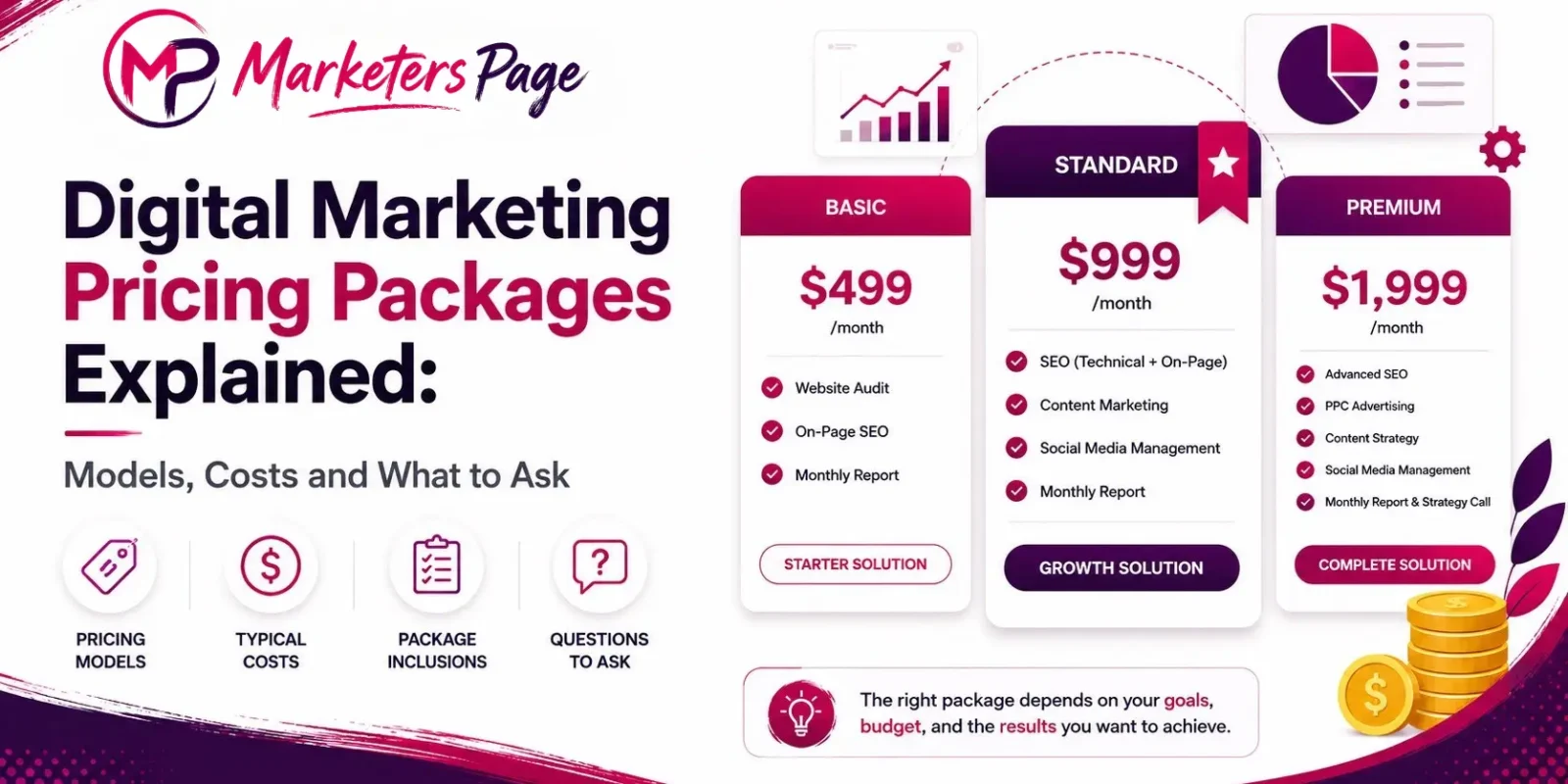
The four tiers below describe what changes as budget increases – deliberately without prices attached.
That’s not evasion. It’s because published price ranges in this category are almost entirely US-market and dollar-denominated, and applying them to Bhubaneswar, Odisha or India generally would produce numbers that are worse than useless. Use the structure to work out which tier your requirements sit in, then use the reverse-engineering test above to check whether any quote you receive is coherent.
Starter
Single channel, defined and narrow. Typically local SEO with Google Business Profile management, or a single Google Ads campaign. Standard monthly reporting. Junior execution against senior-set templates. Suitable for a single-location business with a simple offer and no existing digital presence.
What it can’t do: multi-channel coordination, content at volume, or competitive national keywords.
Growth
Two or three coordinated channels. Ongoing SEO with content production, one paid channel, basic email or lead nurturing. Conversion tracking properly configured. A named account manager and a monthly strategy call. Suitable for a business with proven demand looking to scale acquisition.
The most common tier, and the one where scope discipline matters most.
Advanced
Four or more channels with dedicated specialists per discipline. CRO programme, custom reporting, attribution work, higher content volume. Senior strategist involvement. Suitable for businesses with established revenue where marginal efficiency gains are worth real money.
Enterprise / custom
Priced against the engagement rather than a deliverable list. Dedicated team, martech integration, multi-market or multi-brand coordination, compliance workflows.
When custom genuinely makes more sense: when your requirements don’t map onto anyone’s tiers. If two of the three services you need sit in the Advanced tier and one sits in Starter, you’ll pay for Advanced across the board. A custom scope avoids that.
What a good package must include
Non-negotiable, regardless of tier:
- A named outcome, not just deliverables
- Specified deliverables with quantities and frequency
- Who does the work, by role and seniority
- Monthly hours allocated to your account
- Reporting cadence and format, including which metrics
- Analytics and conversion tracking setup — or confirmation it already exists and has been verified
- Account ownership: your Google Ads, Meta, Analytics and Search Console accounts stay in your name
- Communication protocol: who you contact, expected response time
- Exit terms: notice period, what you keep, how handover works
- Scope change process: what triggers a re-quote
If tracking isn’t in the scope, everything else in the package is unmeasurable. That’s the first thing to check, not the last.
Warning signs of a bad package
Guaranteed rankings or guaranteed lead volume. Nobody controls the algorithm, and nobody controls your market.
No named hours and no named people. You cannot evaluate a price without knowing what’s behind it.
Ad spend and management fee presented as one number. Either sloppy or deliberately obscuring.
Reporting that only contains activity metrics. Posts published, keywords tracked, links built. These describe effort. Enquiries, cost per lead and revenue describe results.
Twelve-month lock-in with no performance review clause. Long commitments are reasonable for SEO. Long commitments with no checkpoint are not.
The agency holds your accounts. Non-negotiable. If they won’t move on this, walk.
A price far below everything else you’ve been quoted. Do the hours math. At a very low fee, the account gets a handful of hours a month – which buys a template, not a strategy.
Vague link-building descriptions. “High-authority backlinks” without a stated method is how sites acquire penalties.
No mention of data handling. Under India’s Digital Personal Data Protection Act, 2023, how an agency collects, stores and processes your leads’ personal data is now your compliance exposure, not just theirs.
Questions to ask before you sign
- How many hours per month does my account receive, and who spends them?
- Is ad spend included, and who holds the ad accounts?
- What outcome are you accountable for, and by when?
- What does your reporting show that isn’t an activity metric?
- How do you acquire links, specifically?
- What happens if we’re not seeing movement at month four?
- What’s the notice period, and what do I keep on exit?
- Which parts of this scope are you subcontracting?
- What would make you tell me to spend less?
- Can I speak to a client in a comparable situation?
Question nine is the most revealing. An agency that has never advised a client to reduce spend or drop a channel is optimising for its own revenue.
How to compare two proposals fairly
Send every provider the identical brief. Then score against a fixed scorecard rather than reading each proposal on its own terms — proposals are written to make comparison difficult.
| Criterion | Provider A | Provider B |
|---|---|---|
| Monthly fee | ||
| Ad spend included? | ||
| Deliverables per month | ||
| Stated monthly hours | ||
| Implied hourly rate | ||
| Seniority on account | ||
| Named outcome + timeline | ||
| Tracking setup included? | ||
| Account ownership | ||
| Contract length + notice | ||
| Reference available |
Wide gaps in the fee almost always trace to one of three things: scope depth, seniority, or deliverable frequency. Identify which before concluding anyone is overpriced.
How to calculate whether it will pay back
The arithmetic is simpler than most people expect. Four numbers:
- Average order or contract value
- Your close rate on enquiries
- Your gross margin
- The monthly fee (plus ad spend, if applicable)
Enquiries needed to break even = Monthly cost ÷ (Average order value × Close rate × Gross margin)
If a package costs ₹50,000 monthly, your average job is worth ₹40,000, you close one in four enquiries and your margin is 40%, each enquiry is worth ₹4,000 in gross profit. You need roughly 13 enquiries a month to break even.
Now ask the agency whether 13 is realistic in your market at that budget. If they can’t answer with reference to search volume and competitive data, they haven’t done the work to quote you properly.
Two timing adjustments. Paid advertising can hit that number within weeks. SEO and content typically take six to twelve months to compound, so the early months run at a loss by design — build that into the calculation rather than judging month three as a failure.
And one adjustment for how search now works. Organic ranking produces fewer visits than it used to. Pew Research Center’s tracking of 900 US adults found users clicked a search result on 8% of visits where an AI summary appeared, against 15% where none did. Any agency modelling SEO returns on pre-2024 click-through assumptions is overpromising. Ask what click-through rates their projections use.
Where India sits in this picture
Two things worth knowing about the market you’re buying in.
The spend is real and growing fast. The dentsu-e4m Digital Advertising Report 2026 put India’s advertising industry at ₹1,21,339 crore at the close of 2025, with digital advertising alone expanding 19% that year to ₹71,621 crore — projected to reach ₹98,034 crore by 2027 and account for close to 70% of total ad spend. Separately, dentsu’s global forecast named India among the world’s fastest-growing ad markets, forecast to expand 8.6% in 2026.
The second thing is less comfortable: there is no credible published survey of what Indian agencies charge. Every pricing benchmark you’ll find quoted online, including the ones in this article, is drawn from US and European respondents reporting in dollars. Indian cost structures are different enough that direct conversion is misleading in both directions.
Which is why the hours-based test matters more here than anywhere. Local currency, local cost base, transparent inputs — that’s a comparison you can actually make.
Digital marketing pricing package checklist
Before signing, confirm you have written answers to all of these:
- Total monthly fee stated clearly
- Ad spend stated separately, with amount
- Deliverables listed with quantities and frequency
- Monthly hours allocated, by role
- Implied hourly rate calculated and sanity-checked
- Named outcome with a timeline
- Which metrics appear in reporting
- Reporting frequency and format
- Analytics and conversion tracking in scope, or verified as existing
- All platform accounts in your business’s name
- Link acquisition method described specifically
- Data handling and DPDP compliance addressed
- Contract length and notice period
- Scope change and re-quote process
- What you retain on exit — accounts, content, data, documentation
- Break-even enquiry volume calculated
- At least one comparable reference contacted
- Same brief sent to every provider quoting
- Performance review checkpoint scheduled
- Escalation path if targets are missed
FAQs
What services does a digital marketing agency provide?
Most agencies offer some combination of strategy, SEO, content marketing, social media management, paid advertising, website and conversion work, email marketing and analytics. Few do all of them well. Ask which two or three they’re genuinely strongest in, and how they staff the rest.
Which digital marketing service gives the fastest results?
Paid advertising, typically within days, provided conversion tracking is in place and the landing page works. Local SEO is often the fastest organic option for businesses serving a defined area. SEO and content marketing generally take several months before compounding.
Do I need SEO if I’m already running paid ads?
They solve different problems. Paid delivers immediate, controllable volume that stops when spending stops. SEO builds an asset that continues producing traffic, but slowly. Most businesses eventually want both. If budget forces a choice, start with paid to validate which messages and offers convert, then invest in SEO for the terms that proved profitable.
Should a new business start with SEO or paid advertising?
Usually paid, because it produces learning faster. You’ll discover which audiences, messages and offers work within weeks rather than months, and that knowledge makes the eventual SEO investment far better targeted.
What’s the difference between social media management and social media advertising?
Management covers organic content, posting and community interaction. Advertising covers paid placements bought through platform ad managers. They use the same platforms but different skills, budgets and success metrics. Confirm which one a proposal includes — assuming it covers both is a common misunderstanding.
Do small local businesses need content marketing?
In a limited form. Pages answering the questions customers actually ask — pricing explanations, process descriptions, service area information — do useful work. A weekly blog usually does not.
What’s the minimum viable set of services for a startup?
Working analytics, a landing page that converts, one paid channel, and email capture. That combination lets you learn what works before spending on anything broader.
Are AI Overviews really reducing website traffic?
The evidence points that way. Pew’s tracking of real browsing behaviour found clicks on search results roughly halved when an AI summary was present, from 15% of visits to 8%. That said, the study covered US users in a single month, and the effect varies significantly by query type — transactional and local searches are far less affected than informational ones.
What is AI search optimization and do I need it yet?
It’s optimising for visibility in AI-generated answers alongside conventional rankings. It matters most if your customers ask informational questions before buying. It’s largely an extension of good SEO practice rather than a separate service, and claims of guaranteed inclusion in AI answers should be treated sceptically.
Can I buy services individually or must I take a package?
Both are available. Individual services suit specific, well-defined problems. Packages suit ongoing programmes across multiple channels. Packaged pricing is often better value if you genuinely need everything included, and poor value if you’re paying for components you don’t use.
Which services should be in-house versus outsourced?
Keep anything requiring deep product or customer knowledge in-house, particularly positioning, messaging and customer research. Outsource work needing specialist tooling or infrequent expertise, such as technical SEO, paid media management and analytics implementation.
How do I know a service is actually working?
Agree on the metric before work starts, and make sure it’s a business metric rather than an activity metric. Posts published, links built and pages optimised describe effort. Enquiries, qualified leads, cost per acquisition and revenue describe results. If a monthly report only contains the first kind, ask for the second.
Before you request quotes
Two things will improve any proposal you receive.
First, know what you’re scoping. Our digital marketing services list explains what each service actually delivers, so you can specify requirements rather than accepting someone else’s bundle.
Second, know what you’re trying to achieve. If the answer is “more leads,” you’ll get generic proposals. Work through the 10-step strategy framework first and you’ll brief every provider from the same document — which is the only way the resulting quotes become genuinely comparable.
And if the metrics in this article need unpacking, our digital marketing fundamentals guide covers ROAS, CAC and the rest.